









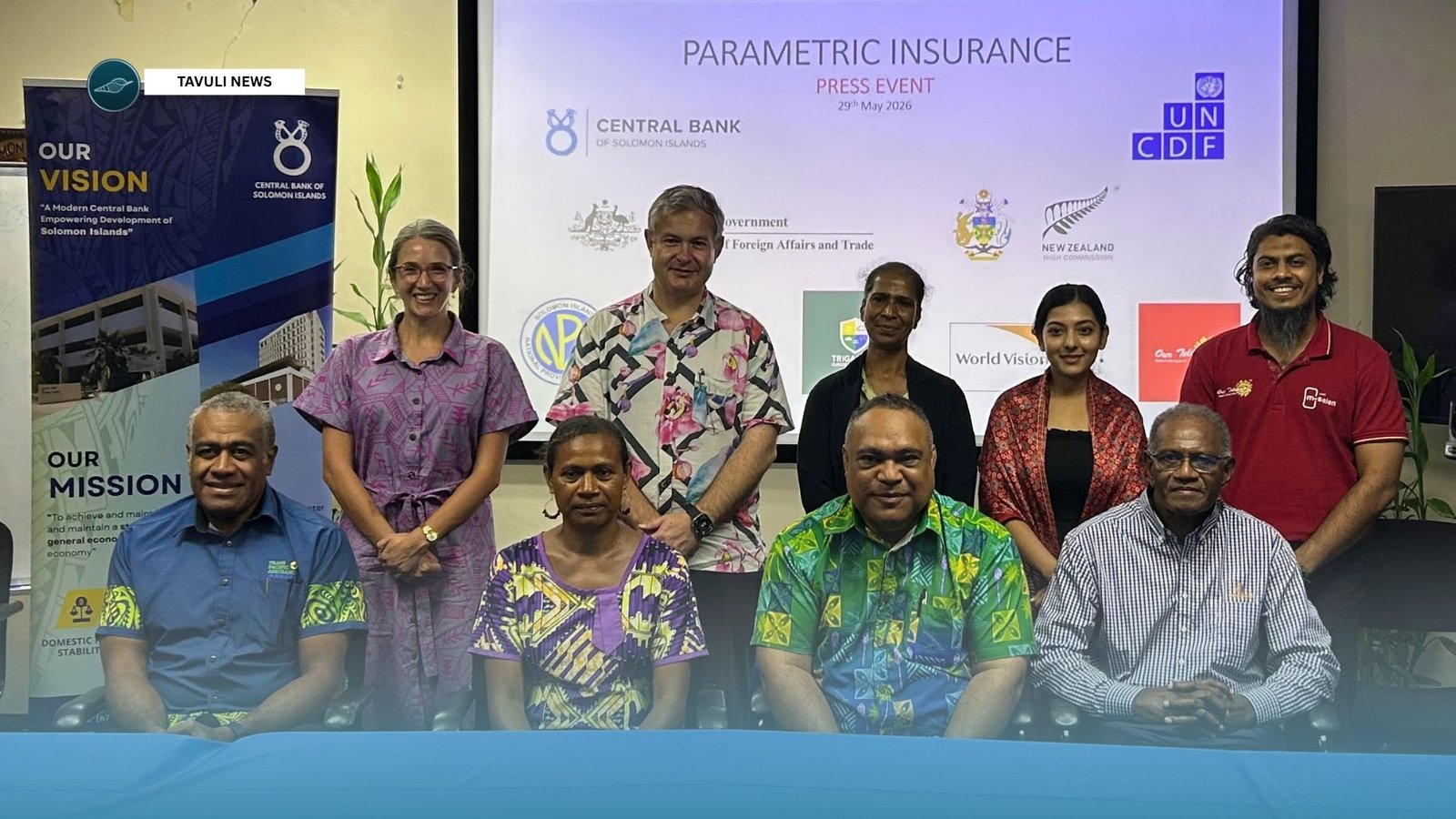
TrigaCash climate insurance helps deliver quick payouts to vulnerable communities after extreme weather events.
Thousands of farmers, fishers, and market vendors across the Solomon Islands are set to receive an automated financial safety net against accelerating climate shocks, following the rollout of a cutting-edge microinsurance platform.
The specialized scheme, operating under the name “TrigaCash,” aims to eliminate the bureaucratic delays that typically stall post-disaster recovery by using real-time meteorological data to trigger instant, automatic payouts. The moment predefined environmental thresholds—such as destructive cyclone winds, extreme rainfall, or prolonged agricultural drought—are independently verified, emergency funds are dispatched directly to policyholders.
The initiative bridges public and private sectors, bringing together the Central Bank of Solomon Islands (CBSI) and the Solomon Islands National Provident Fund (SINPF), alongside World Vision, mobile wallet vendor M-SELEN, Trans Pacific Assurance Ltd (TPAL), and the United Nations Capital Development Fund (UNCDF). Financial backing for the project has been provided by the Australian and New Zealand governments.
Originally launched as a pilot last year 2025, the scheme has already registered more than 300 beneficiaries under the SINPF “YouSave” program across Malaita and Guadalcanal provinces. Following a successful trial that proved the operational viability of trigger-based payouts, financial regulators have confirmed that the infrastructure is being prepared for full-scale nationwide expansion.
Authorities intend to market the microinsurance option directly to the broader YouSave ecosystem, which currently connects roughly 60,000 informal sector workers. The product is expected to expand to the remaining provinces once it officially graduates from the CBSI Regulatory Sandbox process.
Speaking at the Parametric Insurance press event, CBSI Governor Dr Luke Forau praised the initiative, stating that the ongoing realities of the climate crisis require a fundamental shift in how the financial sector approaches community support.
“Financial inclusion in Solomon Islands has long been understood as access to accounts, savings, credit, and payments. That definition is no longer sufficient,” Dr Forau explained. “Inclusion today must also mean protection, where ordinary people have access to financial products that help them manage the real risk they face.”
That risk is particularly acute for the nation’s informal workforce, whose personal wealth accumulation is routinely dismantled by frequent environmental shocks.
“When a cyclone strikes, when the rain floods the garden, the first thing that gets sacrificed is the savings,” observed SINPF Chief Executive Officer Mike Wate. “People do not stop saving because they want to. They stop because immediate demands force their hand. This is the exact problem TrigaCash was designed to address.”
For providers on the ground, the abstract nature of insurance remains a hurdle in rural deployment. Paulo Ralulu, CEO of Trans Pacific Assurance Solomon Islands, acknowledged that convincing informal workers to invest in intangible financial products is historically difficult.
“Insurance is really a promise. It’s not like buying a loaf of bread where you immediately see what you are paying for,” Mr Ralulu said. “This product has given us a lot of encouragement because we’ve seen the evidence of it actually reaching local people in Malaita and Guadalcanal. It is only when disaster strikes that people get that vital, first-hand experience of its value.”
For beneficiaries, that value has already translated into a vital buffer. Alice Hou, a local resident who benefited from the scheme during severe weather earlier this year, highly recommended the platform as a structural alternative to traditional disaster response.
“I used it once at the beginning of the year when there was heavy rainfall in Guadalcanal,” Ms Hou shared. “I received a notification from Trans Pacific Assurance to receive relief funds, which allowed me to send immediate support back home to my family. What I once just shared as information among my household and friends has now become a great structural support in times of need.”
Operating within one of the world’s most disaster-exposed geographies, resource-constrained communities in the Solomon Islands have historically been forced to wait weeks or months for external humanitarian aid packages to arrive post-crisis.
By formalizing rapid, automated cash injections for essential workers, the deployment of TrigaCash introduces an accountable, pre-funded model for climate adaptation. Backed by regional climate financing, the strategy offers a sustainable blueprint for minimizing the economic fallout of extreme weather before local livelihoods are pushed into severe, irreversible debt cycles.