
























































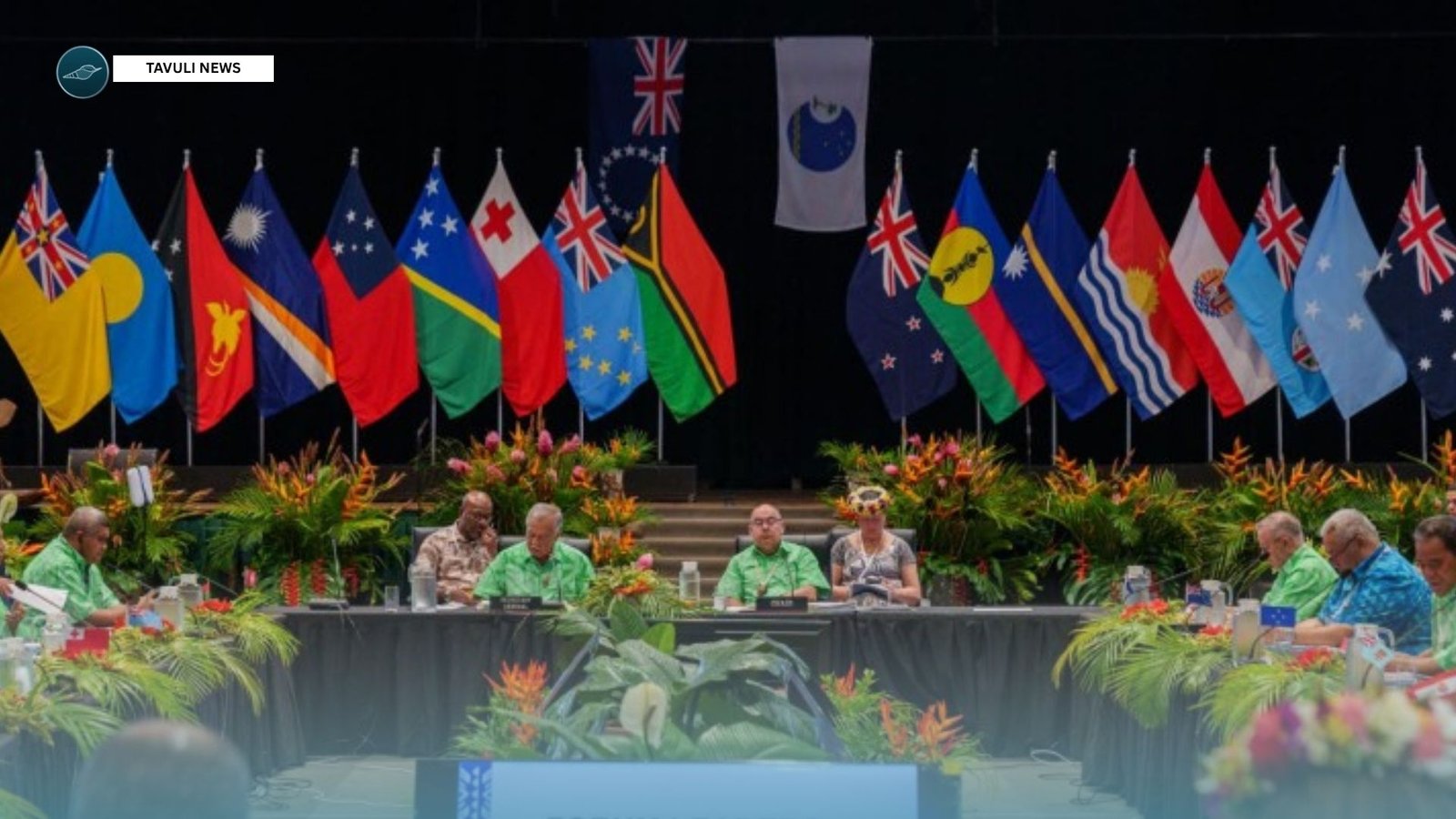
PRNGO Alliance condemns missile tests and militarisation, urging Pacific leaders to protect the Blue Pacific as an Ocean of Peace
The Pacific Ocean is far more than a strategic waterway; it is the foundation of our cultures, identities, livelihoods and futures. It sustains our communities, connects our islands, and underpins our sovereignty and self-determination. Yet today, our ocean is increasingly being treated as a theatre for geopolitical competition, where strategic interests are too often prioritised over the rights, wellbeing and aspirations of Pacific peoples.
The Pacific Regional Non-Governmental Organisations (PRNGO) Alliance unequivocally condemns the recent test of a nuclear-capable intercontinental ballistic missile (ICBM) by the People’s Republic of China across the Pacific Ocean.
We oppose all forms of militarisation and nuclear threats in the Pacific, irrespective of which state is responsible. We cannot condemn missile tests, military build-ups and strategic military expansion undertaken by one power, while remaining silent when comparable actions are undertaken by another. We equally oppose the recent Chinese ICBM test, and the continued testing of Minuteman III ICBMs by the United States over the Pacific, alongside the expansion of military alliances and strategic military partnerships, including AUKUS, large-scale military exercises such as the Rim of the Pacific Exercise (RIMPAC), Valiant Shield, Talisman Sabre, and the continued expansion of foreign military presence and infrastructure across our Blue Pacific.
For Pacific peoples, this is not an abstract geopolitical contest. It is our home.
At a time when the region commemorates some of the darkest chapters in the Pacific’s nuclear history, the continued militarisation of our ocean is a stark reminder that the lessons of the past remain unlearned.
A painful reminder during a month of remembrance
The timing is particularly significant given the major nuclear anniversaries commemorated across the Pacific this month, including the 80th anniversary of Operation Crossroads, when the United States began detonating nuclear weapons at Bikini Atoll in the Marshall Islands; the 60th anniversary of France’s first nuclear detonation at Moruroa Atoll in Ma’ohi Nui (French Polynesia); the 41st anniversary of the bombing of the Rainbow Warrior in an act of French state terrorism intended to silence opposition
1
to nuclear testing in the Pacific; and the ninth anniversary of the adoption of the Treaty on the Prohibition of Nuclear Weapons (TPNW).
For many outside the region, these anniversaries are history, but for Pacific peoples, they remain a lived memory. These anniversaries are more than moments of remembrance. They are also reminders that today’s security challenges cannot be separated from the unresolved legacies of nuclear colonialism, and that the pursuit of genuine peace in the Pacific must begin with acknowledging, addressing and learning from this shared history.
Another missile crossing our ocean cannot be separated from that history. Nor can it be separated from the continued use of the Pacific as a missile testing-corridor, including the regular testing of United States Minuteman III ICBMs towards Kwajalein Atoll in the Marshall Islands. The Treaty of Rarotonga, the Nuclear Free and Independent Pacific movement, and today’s aspiration for an Ocean of Peace were all born from a shared determination that our region should never again become a testing ground for the strategic ambitions of others.
Militarisation is not peace
The Pacific has repeatedly declared its vision of becoming an Ocean of Peace. That vision is not simply the absence of armed conflict, but a Pacific understanding of security founded on justice, sovereignty, self-determination, environmental stewardship and the wellbeing of our peoples.
The recent missile test by China is not an isolated incident. It forms part of a broader pattern of escalating militarisation across our region that includes expanding defence agreements, increasing foreign military deployments, large-scale military exercises such as RIMPAC, Valiant Shield and Talisman Sabre, strategic infrastructure development, and growing geopolitical competition among external powers.
The PRNGO Alliance rejects the notion that military deterrence delivers peace. Escalating military competition is fundamentally inconsistent with the Pacific’s aspiration for an Ocean of Peace.
The Treaty of Rarotonga remains our regional foundation
As the Treaty of Rarotonga approaches its 40th anniversary, Pacific governments should reaffirm and strengthen one of the region’s most enduring commitments to peace and security. Born out of decades of Pacific resistance to nuclear detonations and nuclear colonialism, it declares our region as one of the world’s first nuclear-weapon-free zones and affirms the Pacific’s determination that our region would never again become a nuclear sacrifice zone.
Our call to Pacific Leaders
The PRNGO Alliance’s position is grounded not in the strategic interests of competing powers, but in decades of Pacific regional leadership and civil society advocacy. From the Nuclear Free and Independent Pacific movement and the Treaty of Rarotonga to the Boe Declaration, the 2050 Strategy for the Blue Pacific Continent and the collective positions advanced by Pacific civil society, Pacific peoples have
2
consistently articulated a vision of security founded on justice, sovereignty, self-determination, environmental stewardship, and demilitarisation. Recent events reinforce the urgency of translating those longstanding regional commitments into consistent political action.
The PRNGO Alliance therefore calls upon Pacific Leaders to:
● Unequivocally condemn all missile tests conducted in or across the Pacific Ocean, regardless of whether they are undertaken by China, the United States or any other military power. ● Reject the continued militarisation of the Blue Pacific, including expanding military alliances, foreign military basing, strategic deployments, nuclear deterrence policies and large-scale military exercises such as RIMPAC.
● Reaffirm and strengthen the Treaty of Rarotonga as the cornerstone of Pacific regional security and fully implement its objectives.
● Ensure that any future Ocean of Peace framework is genuinely Pacific-led, centred on human security, environmental protection, Indigenous rights, decolonisation and demilitarisation—not great-power strategic competition.
● Support the universalisation of the Treaty on the Prohibition of Nuclear Weapons, including urging Australia and all Pacific partners that remain outside the Treaty to sign and ratify it. ● Recognise that true regional security requires addressing climate change, ecological degradation, economic inequality and the unfinished business of nuclear justice, rather than expanding military competition.
● Ensure that the future of Pacific security is determined by Pacific peoples, through Pacific institutions, and according to Pacific priorities. Build on an Ocean of Peace founded on human security, regional solidarity and environmental stewardship, and respect for Pacific sovereignty, not on the strategic calculations of external powers.
The Pacific has already paid the price of being treated as a testing ground, a military frontier, and a dumping ground for other nations’ ambitions.
The Pacific Ocean is not a theatre for great-power rivalry. It is our home. It is the foundation of our cultures, identities, livelihoods and futures.
If the Blue Pacific is to become a genuine Ocean of Peace, then militarisation must give way to justice, cooperation, and Pacific-led security founded on sovereignty, self-determination and the wellbeing of our peoples.
(PRNGO) Alliance PRESS RELEASE