






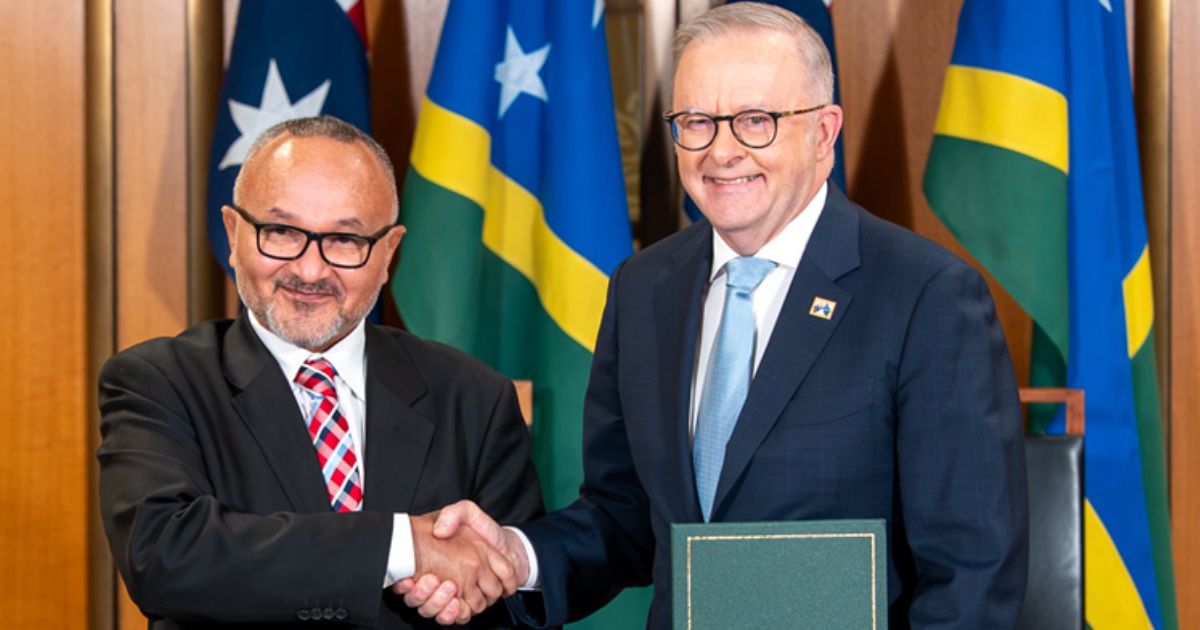
Both countries agreed to consult in advance on security and sensitive infrastructure. Australia also pledged to support fee-free education, with the amount and duration of its contribution yet to be announced.
Solomon Islands has agreed to keep its ports, airports and other sensitive infrastructure free from militarisation, foreign interference and unauthorised access under a treaty signed with Australia in Canberra on Wednesday.
Prime Minister Matthew Wale and his Australian counterpart Anthony Albanese signed the agreement at Parliament House. It names Australia as Solomon Islands’ primary security partner and commits Solomon Islands to barring foreign military and security bases from its territory.
The commitment to consult in advance applies to both governments. The separate obligation to protect sensitive infrastructure, which also includes energy, digital and telecommunications networks, applies only to Solomon Islands. The treaty leaves open which projects would trigger consultation and gives Australia no express power to approve or reject them.
How the treaty changes security cooperation
The 2017 bilateral security treaty set out how Australian police, military and civilian personnel could deploy to Solomon Islands with both governments’ consent. It was first used after the 2021 unrest in Honiara. The multinational mission continued through the 2023 Pacific Games and the 2024 national election.
The new agreement also sets rules for where Solomon Islands seeks security cooperation. In the 2018 Boe Declaration, Pacific Islands Forum leaders reaffirmed each member’s right to address security issues individually or collectively and agreed to strengthen information sharing. Article 5 of the new treaty requires Solomon Islands to draw security cooperation from Forum members. It provides for engagement outside the Forum when members cannot meet a security need, with safeguards for both treaty partners and the wider Pacific.
Australia and Solomon Islands also agreed to share more intelligence and strengthen a long-term policing partnership led by Solomon Islands and supported by Australia.
Questions remain over the China pact
The rules on cooperation outside the Forum come as questions remain about Solomon Islands’ 2022 security pact with China. Asked in Canberra whether his government had discussed ending the pact, Mr Wale cited confidentiality clauses in the security pact and a separate policing agreement. He said talks with Beijing were continuing.
China’s foreign ministry gave no confirmation when asked on Tuesday whether Solomon Islands had told Beijing it would let the pact expire. Spokesperson Guo Jiakun said China’s cooperation with Pacific countries “does not target any third party”.
“There is no element of geopolitical rivalry or bloc confrontation in cooperation between China and Pacific island countries, including the Solomon Islands. Our cooperation does not target any third party and is not subject to third-party influence. The international community should pool efforts to help Pacific island countries realize sustainable development on the basis of respecting their independence, putting development first, and upholding openness and inclusiveness. Relevant cooperation should not target any third party”
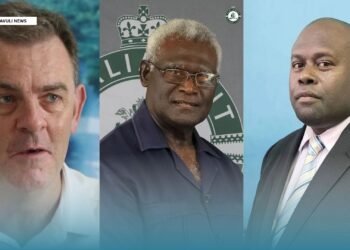
In a statement before the signing, Opposition Leader Manasseh Sogavare asked how the new treaty differed from the 2017 agreement. He questioned why the government was moving quickly to conclude the treaty with Australia while the future of the China security arrangement remained unclear. He said Solomon Islands’ foreign policy should be guided by its national interests.
How much is Australia committing?
Alongside the security provisions, the leaders announced Australian support for the Solomon Islands Government’s fee-free education policy, which is planned to begin in January 2027. The two governments gave no figure for Australia’s contribution or how long it would last. In September, the Ministry of Education said a Cabinet-appointed taskforce was working out the policy’s scope, cost and rollout. How many school years the policy will cover and which fees families may still have to pay remain unclear.
Australia’s existing aid budget estimates A$170.9 million in total development assistance for Solomon Islands in 2026–27. That includes A$103.6 million through its bilateral aid programme, with the rest coming through regional and global programmes and other Australian government agencies. The A$170.9 million figure covers Australia’s overall aid programme for the year. The signing announcement gave no separate figure for fee-free education.
The leaders also announced Australian budget support for community investment. The treaty separately commits Australia to helping establish a Solomon Islands sovereign wealth fund and contributing money to it. Neither commitment was given a dollar figure. The two governments are to draw up a joint plan setting out their funding priorities.
What will change for travellers and workers?
Australia also said it would expand Solomon Islands’ participation in the existing Pacific Australia Labour Mobility scheme. The plans include opportunities in aged care and early childhood care, placements in more locations and additional skills training. The leaders gave no figure for the number of extra places. They also pledged more investment in roads and renewable energy, building on existing cooperation that includes the Tina River hydropower project.
When will the treaty take effect?
Mr Wale said he planned to bring legislation before Parliament in January or February 2027, after the budget. The treaty takes effect once both countries complete their domestic requirements and formally notify each other. A joint body called the Iumi Committee will oversee implementation and meet at least once a year.