








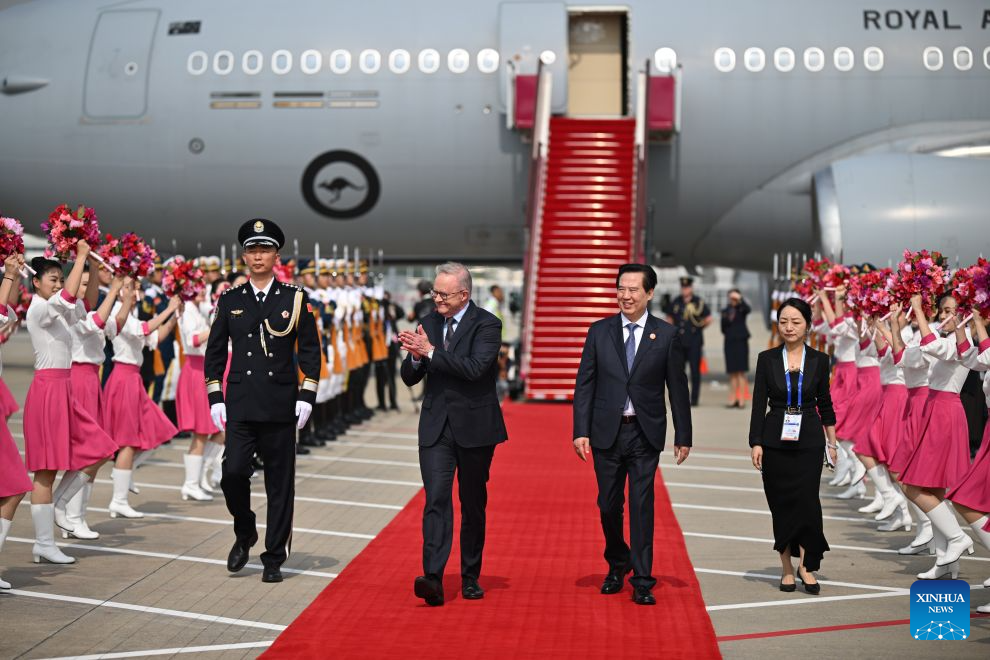
Australian Prime Minister Anthony Albanese has promoted his country’s exports and called for open regional trade during a visit to China for the APEC summit.
Speaking in Shenzhen, Albanese said Australia’s economic relationship with China was important for jobs, growth and regional stability.
China is Australia’s largest trading partner.
“We know that one in four Australian jobs depends upon trade. And over 25 per cent of our exports come to China,” he told reporters.
“So this is about promoting Australian jobs and our economic growth.”
The trip is Mr Albanese’s ninth visit to China and his third as prime minister. His programme includes APEC meetings in Shenzhen and business and political talks in Beijing.
Australian products return to Chinese shelves
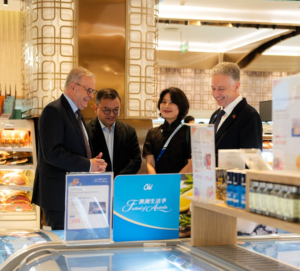
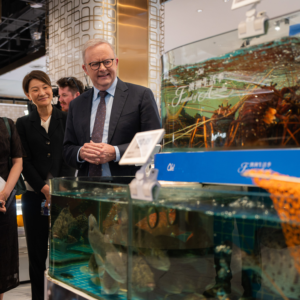
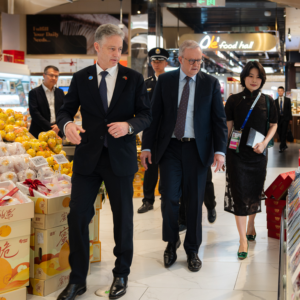
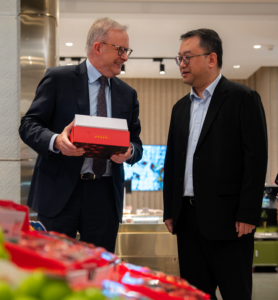
Earlier on Wednesday, Albanese visited a supermarket in Shenzhen where Australian beef, cherries, wine and rock lobster were on sale.
He said the store stocked more than 200 Australian products and was selling Western Australian apples in China for the first time.
The visit provided an opportunity for the prime minister to highlight the restoration of access for Australian goods following a period of trade tensions between the two countries.
Rock lobster from Geraldton, Wagyu beef and Penfolds wine were among the products on display.
The Australian Prime Minister said the exports supported jobs and economic activity, particularly in regional Australia.
However, questions remain about access for some products.
Australian beef exporters currently face tariffs of 55% after exceeding an annual export quota. Asked whether he would press Chinese President Xi Jinping to remove the system, Albanese said his government would continue to advocate for Australian businesses.
“Of course we’d rather not have any quotas on Australian goods anywhere in the world,” he said.
But he added that exporters reaching the quota demonstrated Chinese demand for Australian beef.
“The fact they’ve hit it is a signal that Chinese consumers want to buy Australian beef because of its quality,” he said.
Australia pushes open trade at APEC
Albanese said Australia would use the APEC meeting to support open trade, stronger regional economic integration and practical cooperation between businesses.
The group’s 21 member economies account for 75% of Australia’s total trade in goods and services.
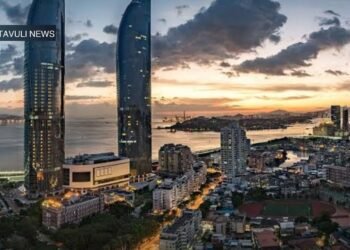
Shenzhen, a major technology and manufacturing centre, is hosting this year’s meetings under the theme “Building an Asia-Pacific Community to Prosper Together”.
The prime minister recalled first visiting the city in 1998 and said its buildings, roads and infrastructure had changed beyond recognition.
He said Shenzhen’s development and its role in innovation made it an appropriate location for the summit.
The city has a population of about 20 million. The surrounding Greater Bay Area, which includes Guangzhou and Hong Kong, is home to about 80 million people.
Albanese described the area as a significant market for Australia.
Ukraine and Port of Darwin also raised
The press conference also covered more contentious foreign policy and domestic issues.
Albanese repeated Australia’s condemnation of Russia’s invasion of Ukraine and said any peace settlement needed to be on Ukraine’s terms.
Asked about Russia’s reported bid to host APEC in 2035, he said the question concerned an event still a long way in the future.
He declined to say whether he would raise China’s links with Russia in meetings with Chinese leaders, saying he did not set out his diplomatic discussions in advance.
On the possibility of appearing alongside Russian President Vladimir Putin in an APEC leaders’ photograph, Mr Albanese said he would bear in mind the wishes of the host country while maintaining Australia’s position on Ukraine.
The prime minister was also questioned about his election commitment to return the Port of Darwin to Australian ownership.
The port is operated by Chinese company Landbridge under a 99-year lease.
Albanese said the government wanted to buy the asset and that discussions with Landbridge were continuing. He acknowledged that legal action and international proceedings remained possible.
He also defended the role of middle-power diplomacy, saying Australia would engage with partners including Canada, Mexico, Japan, South Korea, Chile, Singapore and New Zealand during the summit.