









Sogavare calls on Wale to explain disclosure and conflict management over Attorney-General Suri’s appointment
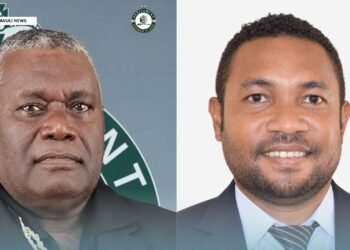
Honiara, Solomon Islands – Leader of the Official Opposition Manasseh Sogavare has called on Prime Minister Matthew Wale to explain how his existing corporate relationship with Attorney-General Gabriel Suri was disclosed and managed during the process leading to Mr Suri’s appointment.
Official company records show that Prime Minister Wale and Attorney-General Suri are recorded as directors of Panatina Chemists Limited. At the same time, Mr Wale is also recorded as holding 552 of the company’s 1,200 shares, representing a 46 per cent shareholding.
Sogavare said the matter raises legitimate questions about transparency and the management of actual or perceived conflicts of interest involving two of the country’s most senior offices.
He stressed that the Opposition is not questioning Mr Suri’s qualifications or alleging corruption, favouritism or unlawful conduct.
“The issue is whether the relationship was disclosed and whether appropriate processes were followed to ensure that any actual or perceived conflict of interest was properly managed,” Sogavare said.
The Opposition Leader said the matter is particularly significant given Prime Minister Wale’s own long-standing position on transparency, accountability and good governance.
During his years as Leader of the Opposition, Mr Wale was among the most vocal in demanding explanations from the previous Government over appointments, relationships and circumstances he believed raised questions about transparency, influence and conflicts of interest. He repeatedly argued that those in authority had a duty to explain themselves where relationships intersected with public decision-making and that he would limit his scrutiny only to cases where wrongdoing could be proven.
That standard was applied to former Prime Ministers Manasseh Sogavare and Rick Hou in previous administrations. Mr Wale publicly raised concerns about relationships, appointments and government decisions and frequently criticised previous governments for what he regarded as failures of transparency, accountability and good governance.
Sogavare said the issue now is whether those same principles apply consistently under Prime Minister Wale’s own Government.
The Prime Minister recently reaffirmed his Government’s position during his opening remarks on the Motion of Thanks to the Speech from the Throne, stating that the Government’s standard on corruption was “zero tolerance”. He said that where public office is abused, public money diverted, or where there is “a shadow of doubt over an official’s integrity”, that official would not remain in the service of his Government, regardless of “who they are or who their friends may be.”
Sogavare said those words reinforce the importance of ensuring that questions surrounding relationships involving senior public office holders are addressed openly and transparently.
“Prime Minister Wale cannot justify conduct today simply because he believed previous governments engaged in similar practices. He came into office promising change. He built much of his political career on condemning previous administrations for what he described as failures of transparency, accountability and good governance.
“He repeatedly demanded higher standards from others and, on occasions, went further by describing previous governments and those associated with them as corrupt or lacking in accountability. The question now is: where is the change?
“Now, as Prime Minister, he has told the country that his Government has a zero-tolerance standard and that even a shadow of doubt over an official’s integrity will not be tolerated, regardless of who that person is or who their friends may be.
“If Prime Minister Wale believed that relationships connected to public appointments and decision-making required explanation when others were in Government, then those same principles must apply when he is Prime Minister. Change cannot simply mean replacing one administration with another while maintaining the same standards and practices that were previously condemned.
“We are not asking the Prime Minister to meet an artificial standard created by the Opposition. We are asking him to meet the standards he has repeatedly set for others and the standards he has now publicly committed his own Government to uphold.
“The public deserves to know whether this Government intends to do things differently or whether the standards that applied to previous administrations are now being treated differently because some of those in office have changed.”
Sogavare said the Attorney-General is not an ordinary appointment, but occupies one of the country’s most important constitutional offices, providing legal advice to Government and playing a central role in ensuring that executive decisions are made in accordance with the Constitution and the law.
He said the public is therefore entitled to know whether the Prime Minister’s directorship and substantial shareholding in a company in which the Attorney-General is also recorded as a director were disclosed when the appointment was under consideration, whether the Prime Minister had any role in the process, and what measures were taken to address any actual or perceived conflict arising from the relationship.
“These are straightforward matters that can be clarified by the Prime Minister,” Sogavare said.
“If the standard was good enough to judge previous governments, it must be good enough to judge this Government. Accountability cannot be demanded only from political opponents and then relaxed when the same questions arise closer to home.
“The issue before the country is not whether anyone should be presumed guilty of wrongdoing. The issue is whether the transparency and accountability standards Prime Minister Wale demanded from others are being applied with the same consistency now that he is in office.”
SOURCE//: OPPOSITION PRESS RELEASE